
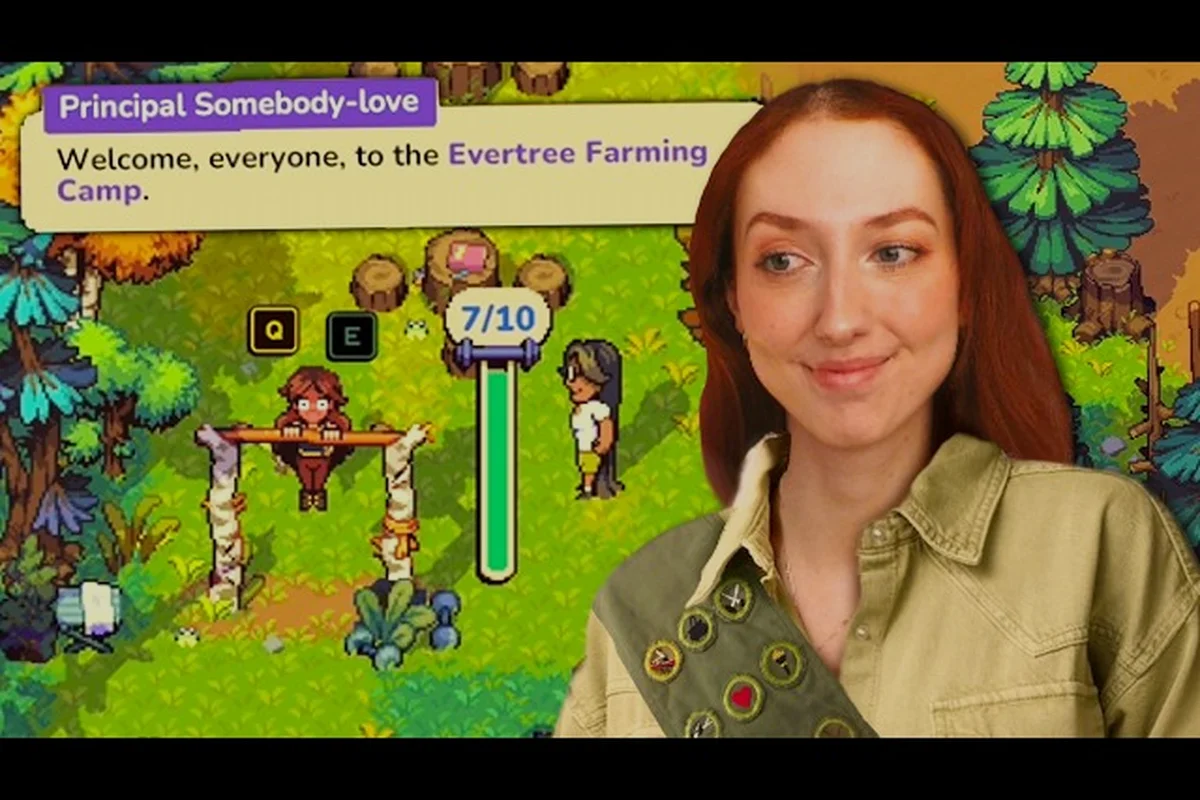
Farming Camp drops you into a single summer at Evertree, a leafy camp where city kid Alessandra would rather be anywhere else. Across roughly 27 in-game days the narrative shifts from reluctant newcomer to a camper who actually has something to prove, and the story branches you plant in week one decide which version of the finale plays out on day twenty-seven. This Farming Camp story summary walks through Alessandra's arc, the plot branches that fork off her choices, and how the final evaluation decides whether Evertree crowns her queen of the hill or sends her home with a Participation trophy.
Who Alessandra Is and Why Evertree Matters
Alessandra arrives at Evertree Farming Camp the way most city kids in this genre show up: dragged there against her will, convinced the whole experience is going to be a waste of a summer. Her parents have signed her up, her bags are packed for her, and the bus ride ends at a gate flanked by a banner that reads somewhere between welcoming and ominous. The opening hour sells the reluctant-protagonist angle, and the official Farming Camp page on Steam tags the title with Story Rich, Female Protagonist and Dialogue Heavy among its user-facing labels, so the writing-first approach is intentional rather than incidental.
Evertree matters in the plot because the camp is built around a single, recurring ritual: the cook-off. Each week the campers are split into teams, handed recipes, and scored on what they manage to plate. Whichever team wins the final cook-off on day twenty-seven gets crowned camp champion, and the protagonist whose name ends up on that trophy decides the shape of the ending. Everything else at Evertree — the animal pens, the kitchen rehearsals, the late-night campfires, the rivalries simmering between returning campers — feeds into that one scoring system.
The cast splits into a few clear groups. The counselors run the chore schedule and arbitrate cook-off disputes, with Rey and Mike acting as the upgradeable partners who can be maxed out for achievement purposes. The returning campers — chiefly a small rival cluster led by characters who have been to Evertree before — push back against Alessandra from day one, framing the story as much around social survival as around cooking. The new arrivals form a third circle of friendships whose affection flags quietly steer which finale Alessandra reaches.
The reason the story resonates with players, judging from the 93-94% positive review ratio cited in the Farming Camp launch post on the official SOEDESCO site, is that the writing treats those small social beats with the same weight as the headline cook-off. A conversation at the well before breakfast can move a flag as decisively as a perfect score in the kitchen.
The Three-Act Structure of the Camp Summer
The plot of Farming Camp divides cleanly into three acts that map onto the day-by-day routine, and the chapter titles used in the Farming Camp chapter walkthrough line up with the same beats. The table below gives a quick overview before the deep dive.
| Act | In-Game Days | Core Conflict | Story Outcome |
|---|---|---|---|
| Act 1: Arrival | Days 1-7 | Alessandra vs. the camp routine | First cook-off placement, first rival |
| Act 2: Teamwork | Days 8-20 | Rising cook-off stakes, friendship forks | Mid-game flag planting, second cook-off |
| Act 3: Final Evaluation | Days 21-27 | Cook-off finale and farewell | True ending, queen ending, or participation ending |
Act 1: Arrival at Evertree (Days 1-7)
The opening act is short and dense. Alessandra meets her assigned partner, gets her starter cabin assignment, and is told in no uncertain terms that the cook-off is what she is being scored on. The narrative hook in this stretch is the rivalry arc: a returning camper publicly dismisses her on day one, and the script frames that line as the through-line the rest of the story will pull on.
Mechanically, days 1-7 introduce every system in miniature. The player waters crops, feeds animals, chops wood, and serves a small dish at the first cook-off. The score there is rarely competitive — the team is still learning the timing windows — but the placement tells the player whether they are on track for a high-friendship or a low-friendship trajectory. By the end of act 1, the social flags Alessandra has or has not planted are already quietly biasing the plot toward one of the three finale branches.
Act 2: Teamwork and Cook-Offs (Days 8-20)
Act 2 is the longest stretch and the one with the most plot branches. This is where the dialogue choice moments land and where the player's relationship with the cast hardens into something the finale can read. The second cook-off on day 14 acts as the act-2 climax: whichever team wins it gets a permanent bonus to the day-27 finale, and the runner-up team has to win a tie-breaker event on day 21 to recover.
Alessandra's character arc in this stretch is about trading isolation for collaboration. The early dialogue options let her keep her guard up, and players who pick those options consistently will lock in a loner-coded path that biases the story toward the Participation ending. Players who open up — accepting a partner's help on a failed recipe, apologizing after a lost cook-off, helping with a side chore that no one asked about — push the flags toward the Queen of the Hill branch.
Act 3: The Final Evaluation (Days 21-27)
The third act is short and scripted. Days 21-26 are about prep: which recipes to rehearse, which teammates to pull into the finale rotation, and how to handle the returning rivals who try to throw last-minute curveballs. Day 27 is the cook-off itself, and the plot resolution depends entirely on the score. This is also where the final evaluation guide mechanics start to matter, because the camp director reads aloud from a scorecard that combines cook-off placement, friendship totals, and individual achievement flags before declaring the winner.
Players who arrive at day 27 with a fully maxed friendship roster and a clean cook-off record trigger a true ending that the community calls the "campfire scene." Players who arrive with one or two soft spots in the friendship totals land in the Queen of the Hill variant, where Alessandra wins the trophy but the farewell feels bittersweet. Players who ignored the relationship system entirely end up with the Participation ending, which is still a complete story but reads as the cautionary version of Alessandra's summer.
How Plot Branches Actually Fork
Farming Camp's plot branches are quieter than they look at first. There is no single binary choice moment that flips a switch; the branches are the cumulative product of dialogue options, friendship gifts, and cook-off placements across the full 27 days. The table below maps the four main branch triggers players tend to miss on a first run.
| Branch Trigger | Where It Happens | What It Tilts |
|---|---|---|
| Day 3 first-cabin dialogue | Choose to share or refuse the spare key | Locks the loner path early |
| Day 10 partner apology | Accept or deflect blame after a failed dish | Shifts the rivalry arc into redemption |
| Day 14 cook-off score | Win, draw, or lose the second contest | Adjusts the day-27 tie-break pressure |
| Day 20 farewell scene | Pick which friend to walk home with | Sets the post-finale epilogue tone |
The branches do not invalidate each other. A player can hit the Queen of the Hill ending on one save and the campfire scene on another without redoing the full 27 days, because the plot branches are score-based rather than script-based. The finale reads the totals, not the route. That is why the Farming Camp finale guide tends to recommend a save before day 20, not a save before day 1.
The story also branches on which team composition Alessandra ends the second cook-off with. A team made up of her earliest friendships scores differently than a team patched together at the last minute, even with identical dish scores. The camp director's scorecard treats team stability as a hidden multiplier, and players who switch partners between acts to chase recipe bonuses will see a small but real dip in the final tally.
Building Flags for the Final Evaluation
The final evaluation on day 27 is a composite score, and the plot only resolves cleanly if at least three of the four major categories are at or near the maximum. The breakdown below reflects what the camp director's scorecard actually reads in the finale cutscene, based on community tracking.
| Scorecard Category | Source | Max | Notes |
|---|---|---|---|
| Cook-Off Placement | Day 14 and Day 27 cook-offs | 40 | Win both for the bonus |
| Friendship Totals | Affinity flags across all campers | 25 | Threshold-gated, not linear |
| Story Achievement Flags | Quest completions and key choices | 20 | The Queen of the Hill trophy lives here |
| Daily Chore Streak | Perfect-day bonus for the cook-off week | 15 | Lost on any missed day-26 prep |
The reason players trip on the final evaluation is that the friendship totals are threshold-gated rather than linear. Affinity has to clear a discrete value per camper before it counts, and a camper at 49% affinity contributes the same as a camper at 1%. The Farming Camp multiple endings guide tracks these thresholds in detail, but the headline point is that the player should aim to push three or four core campers over the line rather than spread thinly across the whole roster.
The story achievement flags are the category most players underestimate. The trophy that matters here is Queen of the Hill, listed in the Farming Camp Steam achievements list as the marker for finishing as the camp winner. Without it, even a perfect cook-off score will not unlock the true finale — the camp director's scorecard reads aloud "winner" but the cutscene routes to the bittersweet variant because the script is keyed to the achievement flag, not the placement.
The Final Evaluation Day, Hour by Hour
Day 27 unfolds in a tight script regardless of branch. Knowing the schedule helps because the player does not get a second chance to fix a low score once the finale starts.
| Time of Day | Event | Can the Player Affect It |
|---|---|---|
| Morning | Team assembly and final dish selection | No — locked in by day-26 prep |
| Midday | Cook-off service | No — script-driven, scored by prep |
| Afternoon | Scorecard reading | No — final totals are read aloud |
| Evening | Campfire scene and ending branch | No — fully cinematic |
The player's only real lever on the final day is the day-26 prep, which is why the broader Farming Camp progression guide treats day 26 as the soft save point. Once the cook-off service starts, the score is locked.
Choices, Dialogues, and Story-Defining Moments
The plot branches are seeded by a small number of high-impact dialogue moments, and missing one of them tends to lock the player into a softer ending even if every other flag is maxed. The table below lists the moments that the community has flagged as the most common silent branch points.
| Moment | In-Game Day | Best Choice for the True Ending |
|---|---|---|
| First cabin key conversation | Day 3 | Share the spare key with the partner |
| Recipe rehearsal apology | Day 10 | Accept the blame for the burnt sauce |
| Partner's late-night question | Day 16 | Answer honestly about why she came to camp |
| Rival's truce offer | Day 21 | Accept the truce, even if it costs a recipe bonus |
| Farewell walk choice | Day 27 | Walk with the partner, not alone |
These are not the only dialogue moments in the game; the script is dense enough that a full playthrough includes well over a hundred spoken choices. The five above are the ones that have the largest documented impact on the finale, and the Farming Camp story choices guide catalogs the rest.
The day-16 conversation in particular carries more weight than its placement suggests. Up to that point, Alessandra can be played as fully guarded, and the story will tolerate it. After day 16, the script starts weighting her private lines against the friendship totals, and a guarded answer on day 16 will quietly dock points from the eventual finale score even if every other flag is maxed. Players who hit a soft ending with apparently perfect scores almost always have a missed day-16 line.
Frequently Asked Questions
How long is the Farming Camp story?
The main plot runs about 10-12 hours for a player who is following the story beats without grinding side content. A completionist run that also chases every story achievement flag stretches the story to roughly 25 hours, because the flag checks force specific replay branches.
Do the plot branches change the cook-off scores?
No, the cook-off scores are independent of the dialogue branches. The branches change which ending cutscene plays after the scorecard is read, not the cook-off placement itself. A player can win both cook-offs and still land in the bittersweet ending if the friendship flags are too low.
Can I see all the endings in one playthrough?
No. The finale is a single cinematic that reads the cumulative flags and routes to one of three endings. To see all of them, the player needs three save files parked before day 20, or three full replays of the second half of the game.
What is the True Ending?
The True Ending is the campfire scene variant, where Alessandra stays behind for an extra night at Evertree and the script confirms she has been offered a counselor role for the following summer. It is gated by the Queen of the Hill story achievement plus a maxed friendship roster, and it is the only ending that resolves the rival's arc cleanly.
Does the final evaluation reward cooking minigame high scores or story choices?
Both, but in different categories. The minigame high scores feed the cook-off placement category (worth 40 of the 100 points), while the story choices feed the story achievement category (worth 20 of the 100). A player who nails the kitchen but ignores the relationship system can still cap out around 80 points and trigger the bittersweet ending rather than the True Ending.